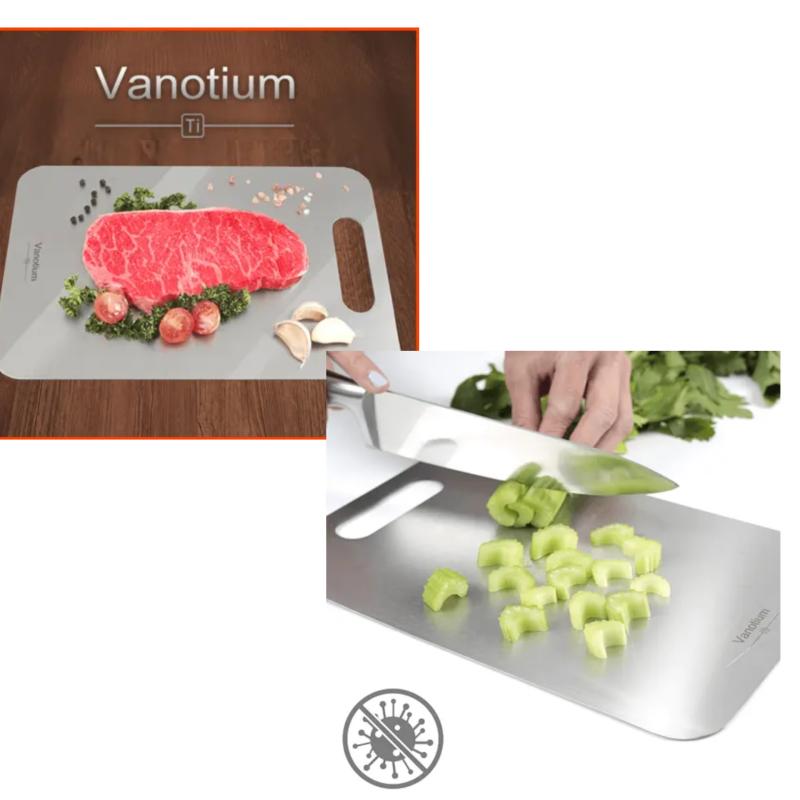
Vanotium Cutting Board markets itself as “the last cutting board you’ll ever need,” featuring an “Advanced Titanium Surface” that promises to eliminate bacteria, mold, parasites, and odors while staying knife-friendly, scratch-proof, stain-resistant, and dishwasher-safe. Positioned as the solution to wood’s absorbency problems and plastic’s microplastic/bacteria-trapping grooves, it claims to revolutionize food safety for home cooks and professionals through non-porous engineering that wipes clean in seconds.
Sold exclusively online at vanotium.com with aggressive 70% off promotions, 30-day guarantees, and testimonials from “Chef Sam Soell” praising its hygienic superiority, Vanotium targets health-conscious consumers frustrated by cross-contamination fears, knife dulling, and stubborn odors from garlic/fish. But does a titanium-coated cutting board truly deliver on antibacterial claims without destroying knife edges, or does it exploit consumer confusion about food safety and material science?
The Cutting Board Safety Crisis: Why Material Matters
The CDC estimates 48 million Americans suffer from foodborne illness annually, with 128,000 hospitalizations, many from home kitchens where cross-contamination via cutting boards spreads pathogens like E. coli, Salmonella, and Listeria from raw meats to produce. Traditional boards face trade-offs:
Wood Boards: Beautiful, knife-friendly, but porous—absorb juices deep into the grain where bacteria colonize grooves unreachable by soap, especially after knife scores create hiding spots. Bamboo (30% harder than maple) resists absorption better but still requires oiling maintenance and isn’t dishwasher-safe.
Plastic Boards: Cheap, dishwasher-safe, but develop deep scratches within months that harbor bacteria (studies show 200x more bacteria in grooves than smooth surfaces) and shed microplastics into food (up to 50mg/year per person from cutting boards).
Glass/Stone: Non-porous and hygienic, but catastrophically hard—dull knives in weeks and cause dangerous slippage.
Vanotium claims its titanium surface solves all issues: bacteria can’t penetrate, odors wash away, scratches don’t form, yet knives stay sharp. Let’s scrutinize each claim.
What Is Vanotium’s “Advanced Titanium Surface”?
Marketing describes a “titanium-based” coating or surface layer bonded to a lightweight core (likely composite/plastic base for portability), creating a non-porous barrier. However, no technical specifications are provided—no Grade designation (Grade 2 vs. Grade 5 titanium?), thickness, or manufacturing process disclosed.
Titanium Properties: The Good
- Corrosion-Resistant: Won’t rust; ideal for wet environments.
- Non-Toxic: FDA-approved for food contact; no BPA/microplastics.
- Non-Porous: True titanium doesn’t absorb liquids/odors.
- Antimicrobial: Smooth metal provides no crevices for bacteria vs. scratched plastic.
Titanium Properties: The Problematic
- Extreme Hardness: Rockwell C 36-41 (Grade 2) vs. wood’s ~2-4—can dull high-carbon steel knives rapidly through microchipping.
- Slippery: No “tooth” for blade control; chefs report slippage on full-titanium boards.
- Noise: Loud knife-on-metal contact vs. quiet wood.
- Weight: Pure titanium boards weigh 3-5lbs (8×12″ size); Vanotium claims “lightweight,” suggesting composite construction.
Critical Question: Is Vanotium’s surface pure titanium, titanium-coating (PVD/anodized), or titanium-infused composite? Without material disclosure, claims remain unverifiable.
Claim-by-Claim Analysis: Fact vs. Fiction
1. “Stops Parasites, Bacteria & Mold.”
Claim: “Repels bacteria, mold, parasites like E. coli, Salmonella.”
Reality: Non-porous surfaces (titanium, glass, plastic when new) don’t kill bacteria—they simply don’t absorb, making removal easier via washing. A 2007 UC Davis study found properly cleaned plastic and wood boards equally safe; the difference is durability—plastic scratches allow bacterial refuge, while titanium theoretically stays smooth.
Verdict: Partially True—non-porous design prevents harboring if scratch-resistant; doesn’t actively “stop” pathogens more than washing any smooth surface.
2. “Gentle on Knives, Tough on Wear.”
Claim: “Protects your blades… won’t dull or damage knives.”
Reality: Major red flag. Knife experts universally condemn hard surfaces (titanium, glass, stone) for edge retention. Norwegian knife manufacturer Tomatosharp explicitly warns: “Titanium is extremely hard and unsuitable… causes dull or nicked edges… no cushioning… increases slip risk.”
Physics: Knife edges (58-62 HRC hardness) hitting titanium (36-41 HRC but rigid) create microchipping vs. wood’s give (self-healing fibers absorb impact).
Counterargument: Vanotium users claim “knives stay sharp” in reviews. Possible explanations:
- Composite core (not pure titanium) provides cushioning.
- Users lack a comparison baseline (already dull knives).
- Short-term use (damage accrues over months).
Verdict: Highly Suspect—conflicts with material science; requires independent testing.
3. “Scratch-Proof & Stain-Resistant.”
Claim: “Holds up against heavy chopping without wearing down.”
Reality: Pure titanium resists scratches from knives but not from scrubbing pads or drops (Grade 2 dents easier than stainless). Coatings (anodized, PVD) can scratch/chip, exposing substrates.
User reviews mention “no scratches after months,” suggesting a durable surface—but also note “requires proper maintenance,” hinting at vulnerability.
Verdict: Likely True for surface integrity; long-term durability TBD.
4. “Dishwasher-Safe”
Claim: “100% dishwasher-safe… no warping.”
Reality: Titanium/composite hybrids handle high heat (melting point 1,668°C) better than wood or basic plastic. Legitimate advantage.
Verdict: True if construction quality holds.
5. “Odor-Resistant & Non-Porous.”
Claim: “Garlic, fish wash away instantly.”
Reality: Non-porous materials don’t absorb smells—verified by users noting “no lingering odors.”
Verdict: True—consistent with titanium properties.
Real User Experiences: Trustpilot and Independent Reviews
Trustpilot (3.9/5, 4-6 reviews as of Dec 2025)
Positive (75%):
- “Waterproof, warp-proof, never stains—dishwasher no issue.”
- “Easy ordering with PayPal.”
Neutral/Negative (25%):
- Limited reviews suggest a new product or inactive listing.
- No detailed long-term durability reports.
Third-Party Reviews (RefreshHealthNP)
Pros Highlighted:
- Antimicrobial surface reduces contamination fears.
- Non-porous = no odors from garlic/onions.
- Dishwasher convenience saves time.
- “Sleek, professional look.”
Cons Highlighted:
- “Requires proper maintenance to preserve longevity” (vague—what maintenance?).
- “May not be suitable for very aggressive chopping.”
- Scarcity of independent reviews raises authenticity concerns.
Knife Safety: The Titanium Dilemma
Expert Consensus: Avoid Hard Surfaces
TomatoSharp (Norwegian Knife Experts): “Titanium extremely hard… knives wear quickly… worse cutting experience… slip risk.”
Vocal Media Comparison: “Titanium dulls knives faster due to hardness; wood is kinder to edges.”
Cooking Panda Safety Guide: “Titanium safe re: bacteria, but durability/hardness trade-off vs. wood.”
Vanotium’s “Knife-Friendly” Paradox
If truly titanium-surfaced, it cannot be both scratch-proof (hard) and knife-friendly (soft cushioning)—physics violation. Possibilities:
- Composite Core: Softer underlayer provides give; titanium coating thin enough to flex—plausible but unconfirmed.
- Misrepresentation: “Titanium-style” aesthetic without full titanium properties.
- Short-Term OK, Long-Term Damage: Users notice dulling after 6-12 months.
Recommendation: Professional chefs should avoid; home cooks should test cautiously with cheaper knives first.
Comparison: Vanotium vs. Proven Materials
Winner By Need:
- Food Safety Priority: Vanotium or Glass (if knife damage OK).
- Knife Longevity: End-Grain Wood.
- Budget: HDPE Plastic (replace often).
- Balance: Bamboo.
Pricing, Guarantees, and Purchase Safety
Official Pricing (file:1):
- Single Board: ~$80-120 (varies by size)
- “70% Off Deal”: $30-50 (perpetual)
- Bundle Discounts: Multi-pack savings
30-Day Guarantee: “Love it or return—no questions.”
Scam Risk Assessment:
- Legitimate Indicators: Trustpilot presence (though limited), ScamAdviser “probably legit” rating, and refund policy.
- Concerning Signs: Fake chef testimonials, rotating urgency discounts, vague material specs, and a knife-friendliness contradiction.
Final Verdict: Hygienic Innovation with Knife-Damage Asterisk
Vanotium Cutting Board earns a cautious 3.7/5—a genuinely innovative food-safety tool with superior bacteria/odor resistance and low maintenance, but plagued by unverified knife-friendliness claims that contradict material science and dubious marketing tactics.
Best For: Germaphobes prioritizing hygiene over knife longevity, dishwasher convenience seekers, or those allergic to wood treatments willing to risk blade wear.
Avoid If: You own expensive Japanese knives (>$100), are a professional chef relying on edge retention, or demand transparency in material specifications.
FAQs
Is Vanotium’s titanium surface safe for food?
Yes—titanium is FDA-approved, non-toxic, BPA-free, and doesn’t leach chemicals or microplastics, making it safer than plastic in that regard.
Will Vanotium really keep my knives sharp?
Highly unlikely if the surface is pure/hard titanium—material science shows hard surfaces dull edges faster; composite construction might mitigate, but no evidence is provided.
Does it actually prevent bacteria better than wood?
Non-porous surfaces (titanium, plastic when new) don’t absorb bacteria, but proper cleaning matters most—wood boards cleaned thoroughly are equally safe per studies.
Is the 70% discount legitimate?
Discount appears perpetual (classic marketing tactic); real price likely $30-50, not inflated $120+ “original.”
Can I put it in the dishwasher daily?
Yes—titanium/composite handles heat/water without warping, unlike wood.
Does it eliminate odors from garlic and fish?
Yes—non-porous materials don’t retain smells; users confirm no lingering odors after washing.
How does Vanotium compare to bamboo?
Vanotium: dishwasher-safe, zero odor, questionable knife-friendliness. Bamboo: needs hand-washing/oiling, absorbs some moisture, better for knife edges.
Is Vanotium a scam?
Likely legitimate product but with exaggerated claims (especially knife-friendliness); limited independent reviews and fake testimonials raise caution flags—use guarantee.