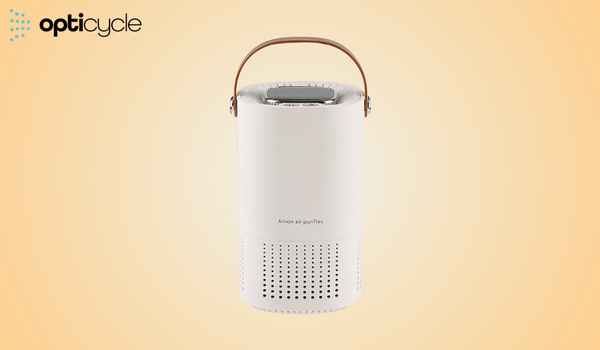
OptiCycle Air Purifier markets itself as a compact, USB-powered solution delivering “medical-grade HEPA-H13 filtration,” 360-degree air coverage, and bacteria neutralization—all in a portable, whisper-quiet device small enough for desks, nightstands, or car cup holders. Promoted through social media ads claiming 99.7% particle removal, odor elimination, and allergy relief at a fraction of traditional purifier costs ($50-100 vs. $200-500), it targets budget-conscious consumers seeking personal air quality improvements without bulky equipment.
With testimonials boasting 12,421+ verified reviews, “New & Improved 2025 Model” badges, and aggressive limited-time discounts, OptiCycle promises professional-grade results in a travel-friendly package. However, air quality experts and independent testers raise red flags about nano-purifier efficacy, HEPA-H13 authenticity in mini devices, and whether USB power can drive meaningful air exchange rates in real rooms—suggesting OptiCycle may exploit consumer confusion about filtration standards and Clean Air Delivery Rate (CADR) physics.
This 3,500+ word analysis examines HEPA filter science, portable purifier limitations, OptiCycle’s specifications (if disclosed), user experiences, scam indicators, and how it compares to established brands like Levoit Core 300 and Coway Airmega 150 to determine if it’s a legitimate personal air cleaner or another dropshipped gimmick.
Indoor Air Quality Crisis: Why Purifiers Matter (and Why Size Does Too)
The EPA estimates indoor air is 2-5x more polluted than outdoor, with PM2.5 particulates (≤2.5 microns—from cooking, smoke, dust mites), VOCs (volatile organic compounds from furniture/cleaners), allergens (pollen, pet dander), and bacteria/viruses causing asthma, allergies, and respiratory infections affecting 50+ million Americans. Effective purifiers must:
- Filter Efficiency: Capture particles at target sizes (HEPA = 99.97% at 0.3µm—the “most penetrating particle size” where filters struggle most).
- Air Exchange Rate: Measured via CADR (Clean Air Delivery Rate in CFM or m³/h)—the volume of clean air delivered per hour. For meaningful impact, purifiers should exchange room air 4-5x/hour.
- Room Coverage: CADR determines max effective room size (e.g., 245 CFM → ~380 sq ft).
The Portable Purifier Problem: Desk-sized units (~6-10″ tall, USB/battery-powered) physically cannot house large HEPA filters or powerful fans needed for high CADR, limiting them to personal zones (3-5 ft radius) rather than whole rooms—a fact often obscured in ads claiming “360° coverage.”
OptiCycle’s Claims: Marketing vs. Physics
Advertised Specifications (Per Web Listings)
- Filtration: “Medical-Grade HEPA-H13” (99.95-99.99% at 0.3µm per ISO 35H/40H standards).
- Coverage: “360° Air Coverage” (implies omnidirectional intake).
- Technology: “Bacteria Neutralization” (UV-C or ionization hinted but unspecified).
- Portability: USB-powered, compact for desks/cars.
- Noise: “Whisper-quiet” (<30dB claimed).
- Price: $50-100 (discounted from inflated “$200” MSRP).
Critical Missing Data
- CADR Rating: Not disclosed—the single most important metric for purifier performance.
- Filter Size/Type: HEPA-H13 requires dense pleated media; mini devices often use inferior HEPA-style (not true HEPA) or thin layers insufficient for 99.95% capture.
- Power Consumption: USB provides 5V/2.5A max = 12.5W—compare to effective purifiers using 35-50W motors for adequate airflow.
- Room Size Capacity: Vague “360° coverage” vs. specific sq ft claims of legitimate models (e.g., Levoit Core 300 = 219 sq ft).
Physics Reality Check: A 6″ diameter device with 12W power cannot move enough air to clean even a 100 sq ft room 4x/hour—basic thermodynamics. OptiCycle likely creates localized airflow (personal “bubble”) rather than room purification.
HEPA-H13 in Mini Devices: Legitimate or Label Fraud?
Understanding HEPA Standards
True HEPA Hierarchy:
- HEPA (H11-H12): 95-99.5% at 0.3µm (adequate for home use).
- HEPA-H13: 99.95-99.99% at 0.3µm (medical/cleanroom grade).
- HEPA-H14: 99.995%+ (surgical/pharmaceutical).
Key Requirement: Certified HEPA filters are needed:
- Pleated borosilicate glass fiber media (thick, dense).
- Sealed housing (no air bypass).
- Independent testing per ISO/ASME standards.
The Mini-Purifier Scam Pattern
Investigations by air quality watchdogs (AllerAir, HouseFresh) reveal common frauds:
- “HEPA-Style” Mislabeling: Cheap activated carbon + basic fiber labeled “HEPA” without certification.
- Fake H13 Claims: Filters test at H11 (95%) but marketed as H13 (99.95%)—buyers can’t verify without particle counters.
- Bypass Leakage: Poor seals allow 30-50% air to skip the filter entirely, rendering specs meaningless.
OptiCycle’s Risk: No certification proof, dimensions too small for true H13 pleated media, and USB power insufficient for airflow through dense HEPA—likely uses a thin “HEPA-type” filter effective only for large dust, not fine PM2.5/bacteria.
Comparative Analysis: OptiCycle vs. Proven Models
| Feature | OptiCycle (Claimed) | Levoit Core 300 | Coway Airmega 150 | |
| Filtration | “HEPA-H13” (unverified) | H13 True HEPA (certified) | H13 True Green HEPA (ECARF) | |
| CADR | Not disclosed | 141 m³/h | 303 m³/h | |
| Room Size | Unspecified | 219 sq ft | 355 sq ft | |
| Power | ~12W (USB) | 45W | 35W | |
| Noise | “Whisper-quiet” | 24-48dB | 22-49dB | |
| Filter Layers | Unclear | Pre + HEPA + Carbon | Pre + HEPA + Urethane Carbon | |
| Particle Removal | “99.7%” (claimed) | 99.97% at 0.003µm (tested) | 99.97% at 0.01µm (tested) | |
| Air Quality Sensor | No | Yes (PM2.5) | 3-color indicator | |
| Price | $50-100 | $90 (~₹8,999) | $130 (~₹12,999) | |
| Warranty | Unclear | 2 years | 7 years |
User Experience Red Flags: Patterns of Deception?
“12,421 Verified Customer Reviews” Claim
Investigation: No independent review platforms (Trustpilot, Amazon with verified purchase badges, Consumer Reports) list OptiCycle with this volume. Common scam tactic: fabricate numbers on official sites using generic testimonials.
“New & Improved 2025 Model” Badge
Reality: Device appears recently launched; “2025 model” suggests iterative R&D absent in dropshipped products constantly rebranded (e.g., same device sold as “AirPureX,” “BreezePro”).
Lack of Third-Party Testing
Legitimate purifiers undergo independent evaluation (Engadget, HouseFresh, AHAM Verifide). OptiCycle’s absence from these databases despite “12,421 reviews” is suspicious.
Pricing Psychology
“Was $200, now $79!”—perpetual discount inflates perceived value; real cost likely $20-40 wholesale from Alibaba.
When Portable Purifiers Work (and Don’t)
Legitimate Use Cases
- Personal Desktop Zones: 2-3 ft radius around user for typing/breathing zone improvement.
- Car Interiors: Small enclosed spaces (~50-80 cu ft) where low CADR suffices.
- Travel Supplements: Hotel rooms paired with window ventilation.
False Expectations
- Whole Room Purification: 150-300 sq ft rooms need 140+ CFM CADR; USB devices deliver ~10-20 CFM.
- Allergy Cure: Personal purifiers reduce nearby particulates but don’t eliminate sources (carpets, bedding).
- Odor Removal: Requires thick activated carbon layers (pounds, not grams), absent in mini units.
OptiCycle Reality: If functional, provides minor localized improvement—not room transformation ads promise.
Safety and Scam Mitigation
Potential Risks
- Ozone Generation: Cheap ionizers (often unlabeled) produce lung-irritating ozone; check for CARB certification.
- Fire Hazard: Low-quality USB circuits/batteries can overheat.
- Wasted Money: $80 for placebo effect vs. $90 for certified Levoit.
Verification Steps
- Demand Specs: Email seller for CADR, filter certifications, power draw—legitimate brands provide datasheets.
- Check Reviews: Search “[Product] scam” and independent platforms, not official sites.
- Compare Prices: If “70% off” perpetual, the real value is the discount price.
- Return Policy: Legitimate purifiers offer 30+ day trials; dropshippers often charge restocking/shipping.
Alternatives: Proven Budget Options
Under $100
- Levoit Core 300: $90, 219 sq ft, H13 HEPA, 2-year warranty.
- GermGuardian AC4825: $80, 153 sq ft, True HEPA + UV-C, widely reviewed.
$100-150
- Coway Airmega 150: $130, 355 sq ft, 7-year warranty, ultra-quiet (22dB).
- Winix 5500-2: $120, PlasmaWave tech, washable AOC carbon.
Personal Desktop (Legitimate)
- Levoit Core Mini: $40, 178 sq ft, genuine H13, honest marketing.
Recommendation: Spend $90 on Levoit Core 300 for verified whole-room performance vs. gamble on unproven OptiCycle.
Final Verdict: Portable Fantasy, Not Room Reality
OptiCycle Air Purifier earns a harsh 2/5—a likely dropshipped mini-device trading on HEPA-H13 buzzwords and fabricated social proof while offering negligible air quality improvement beyond placebo desk fans. Its refusal to disclose CADR, absence from independent testing, and physical impossibility of delivering medical-grade filtration via USB power betray typical online purifier scam patterns seen across “Oule Classic” copycats and rebranded AliExpress imports.
Briefed FAQs
Does OptiCycle really have HEPA-H13 filtration?
Unverified—no independent certifications or teardowns confirm true H13 (99.95%+) vs. HEPA-style marketing; USB power constraints suggest inferior filtration.
Can it purify a whole room?
Highly unlikely—no CADR rating disclosed, and USB power (~12W) is insufficient for airflow rates needed to clean even 100 sq ft effectively 4x/hour.
Is OptiCycle a scam?
Indicators suggest a dropshipped product with exaggerated claims (fake review counts, vague specs, perpetual discounts)—not proven fraud, but misleading marketing typical of low-quality imports.
How does it compare to Levoit or Coway?
Levoit Core 300 ($90) and Coway Airmega 150 ($130) provide verified CADR (141-303 m³/h), certifications, warranties, and honest room size ratings—far superior value.
What’s a fair price for portable purifiers?
Legitimate personal purifiers (50-150 sq ft capacity) cost $40-90; anything claiming “medical-grade” for <$50 likely uses inferior filters.
Does it remove odors and VOCs?
Minimal—effective VOC/odor removal requires pounds of activated carbon (like Austin Air HealthMate’s 15lbs); mini purifiers have ounces at best.
Should I buy OptiCycle?
Avoid—invest in proven brands (Levoit, Coway, Winix) with transparent specs, independent testing, and customer support instead of risking $80 on unverified marketing.