Ambient lighting devices and decorative room projectors occupy a massive corner of the direct-to-consumer gadget market. Promoted heavily across video feeds and social storefronts, the StarNest Galaxy Night Lamp Projector is pitched as a simple way to coat a bedroom ceiling in drifting nebulae and sharp star fields. The appeal is straightforward: low-cost mood lighting that makes a bedroom, gaming desk, or living area look visually striking without the hassle of hanging strip lights or repainting.
The challenge for shoppers comes down to substance versus presentation. Direct-response gadget campaigns tend to showcase ideal conditions, filtered visuals, and sweeping claims about relaxation or sleep improvement, while offering very little hard data about build materials, electrical specs, or the business handling the order.
This review breaks down the StarNest projector from an independent consumer standpoint. Below, we look at the internal hardware mechanics, verified features, optical safety, realistic use cases, buyer feedback trends, and the purchasing terms on the checkout page.
What Is StarNest – Galaxy Night Lamp Projector?
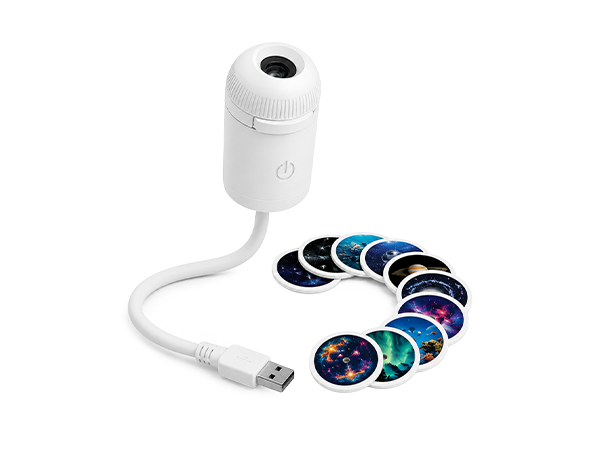
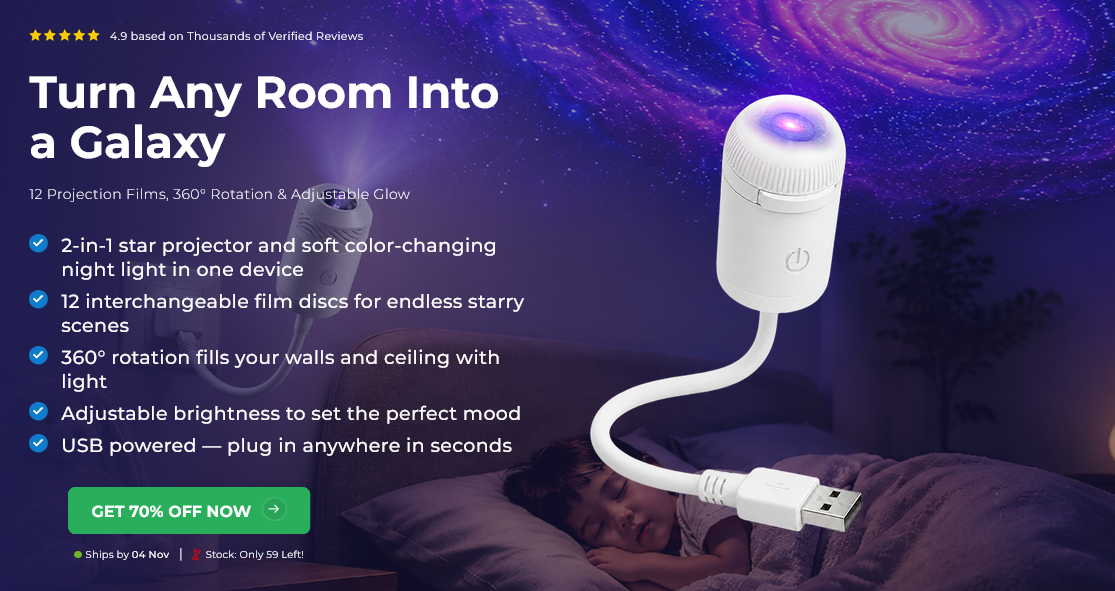
The StarNest Galaxy Night Lamp Projector is a compact, plug-in ambient light projector designed to cast moving, colored light formations onto indoor walls and ceilings. It belongs to the broader class of consumer novelty projectors often produced by contract manufacturers and distributed by private-label online brands under various brand names.
The projector serves as an aesthetic room accent. It aims to deliver a calming or visually interesting backdrop for sleeping, movie watching, or gaming. It is strictly a decorative gadget. It does not map real constellations; it cannot function as an educational astronomy tool, and it lacks the illumination output needed to replace a standard desk lamp or reading light.
How Does StarNest – Galaxy Night Lamp Projector Work?
The device relies on a simple, dual-source optical setup: high-output LEDs handle the wide, shifting color fields, while an independent laser diode projects a grid of fine, high-contrast pinpricks that mimic stars.
Inside the plastic chassis, the LED light passes through a textured, semi-translucent glass or plastic disc. A small electric motor slowly turns this disc, bending and refracting the light as it moves. That mechanical rotation produces the liquid, drifting “nebula” effect cast across the ceiling. Meanwhile, the laser beam passes through a diffraction grating, splitting a single coherent beam into hundreds of tiny individual dots.
Users control the output through physical buttons on the housing or an included infrared remote. These controls adjust:
-
Motor speed (stopping the drift entirely or setting it to cycle continuously)
-
Color combinations (blending red, green, blue, and white LED channels)
-
Brightness settings (stepping down intensity for darker rooms)
-
Laser status (leaving the stars steady, pulsing them, or shutting them off)
The projection depends entirely on how the room is set up. In a pitch-black room with standard eight-to-nine-foot flat ceilings, the coverage is crisp and vibrant. In rooms with vaulted ceilings, off-white paint, or ambient light bleeding in from streetlights or hallway lamps, the contrast washes out quickly.
The projector must remain tethered to power via its USB cable during use. It does not carry an internal rechargeable battery, so placing it on a central table or high shelf requires routing a cord to an outlet or running it off an external battery pack.
StarNest Galaxy Night Lamp Features Breakdown:
Direct-to-consumer electronics in this bracket share a fairly standard architecture. Here is how the core hardware and functional components break down in practice:
-
Dual-Layer Light Engine: The split setup lets you run the LED clouds and the laser stars independently. If the moving nebula feels too distracting before sleep, you can run static stars; if the laser dots are too harsh, you can switch them off and leave a soft, shifting wash of color.
-
Remote Control Operations: Most packages ship with a compact infrared remote. It handles color switching, fade speeds, and sleep timers without forcing you to get out of bed to press buttons on the base. Like most budget infrared remotes, it requires a direct line of sight to the sensor on the unit and can be finicky from across a large room.
-
Low-Voltage USB Power: Running on a standard 5V USB connection keeps power consumption minimal, usually pulling between 5 and 10 watts. The downside is that the seller rarely includes a dedicated high-efficiency wall block, leaving buyers to supply their own phone charger or open USB hub.
-
Plastic Shell and Heat Management: The housing is lightweight molded plastic. Because LEDs and small drive motors generate modest internal heat over several hours of continuous runtime, passive ventilation slots are molded into the shell.
A persistent issue with units sold through temporary promotional storefronts is the absence of detailed specification sheets. Metrics like operating noise decibels, diode life expectancy, exact lumen output, and specific laser classifications are routinely left out of the sales material.
Benefits & Practical Use Cases
When measured against sensible expectations, the StarNest projector delivers distinct utility in a few specific scenarios, balanced by clear hardware realities.
-
Casual Room Styling: It delivers an immediate visual overhaul to a dark room with zero renovation. For teenagers, college students in dorms, or apartment renters who cannot paint walls or install permanent fixtures, it provides dramatic decorative lighting on demand.
-
Low-Key Background Ambience: For casual movie nights, background lighting during gaming sessions, or relaxed listening spaces, the muted, moving light provides enough illumination to navigate a room without washing out monitors or television screens.
-
Straightforward Setup: There are no companion apps to configure, no Wi-Fi pairing requirements, and no account registrations. You plug in the cord, point the lens at the ceiling, and press power.
The limitations, however, are just as concrete. The moving light effects are occasionally advertised as tools that actively treat insomnia or relieve clinical anxiety. While dim, warm light can certainly be part of a restful nighttime environment, there is no clinical evidence that this particular device alters sleep architecture or treats sleep disorders. Furthermore, the small internal motor that spins the optical lens can develop a low, audible hum over time, which can bother sensitive sleepers.
Who Should Use StarNest Galaxy Projector?
The StarNest projector fits a defined type of buyer:
-
College students and apartment dwellers looking for cheap, portable room decoration that packs away into a bag.
-
Parents wanting a fun visual distraction or gentle night light for older children’s bedrooms, provided the unit is kept securely out of reach of small hands.
-
Desk workers and gamers who want gentle, indirect ambient lighting around their setup to reduce eye strain from bright display screens in dark rooms.
It is generally not a good fit for:
-
Astrophysics or astronomy enthusiasts who expect anatomically accurate star charts, constellations, or planetary projections.
-
People sensitive to mechanical noise, as budget rotating motors can produce a steady mechanical whir that becomes noticeable in a silent bedroom.
-
Shoppers wanting smart-home automation, since basic infrared models will not integrate natively into Apple Home, Google Home, or automated routines without third-party IR blasters.
Safety, Side Effects & Precautions
Small consumer electronics that mix moving mechanical parts with laser diodes require a few basic safety habits:
-
Direct Laser Exposure: The primary safety concern centers on the green or blue laser aperture. Laser diodes used in consumer projectors are typically designed to fall under lower hazard categories (such as Class 2 or Class 3R), but looking directly into the aperture at close range can cause temporary visual flash blindness or retinal strain. The unit should always be placed high enough or angled so that occupants do not look directly down into the lens.
-
Photosensitivity and Seizure Triggers: People diagnosed with photosensitive epilepsy or individuals who experience migraines triggered by rhythmic, moving, or cycling lights should avoid rapid motion modes or pulsing laser presets.
-
Cable and Placement Hazards: Because the unit relies on a constant cord connection, trailing USB wires can become tripping hazards in a dark room. Keeping the wire neatly tucked along baseboards or furniture edges prevents accidental drops.
-
Power Supply Integrity: Many direct-to-consumer electronics ship without an approved AC adapter. Always plug the USB lead into a reputable, safety-certified (UL or ETL listed) wall plug rather than an unbranded, bargain-bin USB adapter to prevent overheating.
Pros & Cons of StarNest Night Lamp:
| Pros | Cons |
| Rich, vibrant color saturation in fully darkened rooms | Exact laser classification and electrical specs are not published |
| Dual-light controls let you toggle stars and clouds separately | Internal rotation motor can develop an audible hum over time |
| Simple USB plug-and-play operation with no apps required | Lightweight plastic construction feels fragile if dropped |
| Compact footprint fits easily on a nightstand or bookshelf | IR remote needs direct line-of-sight to the front sensor |
| Low power draw makes it cheap to run for extended hours | Lacks smart-home compatibility and native app control |
Customer Feedback: What Do Buyers Say?
Customer feedback on devices of this design reflects a predictable split between aesthetic satisfaction and hardware durability:
-
What buyers like: Satisfied owners consistently mention the visual impact. In dark rooms, the colors look vivid, and the blend of rotating cloud patterns and sharp star points looks impressive on a flat white ceiling. Parents frequently note that older kids enjoy falling asleep to the drifting patterns, and gamers appreciate the moody backdrop behind streaming setups.
-
Common mechanical frustrations: The most frequent complaints center on internal motor noise. While whisper-quiet out of the box, the miniature plastic gears driving the rotating lens can begin to click, scrape, or buzz after a few weeks of nightly use. Others report that the remote control feels cheap, with spongy buttons and a narrow reception angle.
-
Delivery and support friction: Buyers ordering through single-product promotional funnels often report longer-than-expected shipping times, basic packaging with minimal protective padding, and limited responsiveness from online support forms when attempting to process an exchange.
The overall feedback pattern indicates that while the visual effects generally match expectations, the long-term mechanical reliability varies widely from one production run to the next.
Pricing, Warranty or Refund Policy
Understanding the commercial terms before checking out helps prevent unpleasant surprises:
-
Pricing Dynamics: The StarNest projector is generally marketed on tiered pricing schemes. A single unit typically sells somewhere between $20 and $40, with checkout funnels aggressively pushing two-, three-, or four-unit bundles at supposedly steep volume discounts.
-
Checkout Add-Ons: Watch out for pre-checked boxes on the payment screen. Promotional funnels frequently attempt to tack on “priority handling,” “extended replacement plans,” or extra cables unless you manually uncheck them before submitting payment.
-
Return Conditions: Refund policies on these direct-to-consumer sites tend to be strict. Most specify a 14-to-30-day window from the delivery date, often stipulating that the box must remain unopened and in original factory condition. If you open and test the product, returning it for a full refund can be difficult, and the customer is almost always responsible for paying tracked return shipping out of pocket.
-
Warranty Support: Clear, multi-year manufacturer warranties are essentially non-existent on these storefronts. Once the short initial return window closes, buyers have little recourse if an internal diode burns out or the motor stops spinning.
Pay using a credit card or a payment service with robust purchase protection (such as PayPal) to ensure you have a fallback option if the package fails to arrive or arrives damaged.
Frequently Asked Questions (FAQs)
Q. What does the StarNest Galaxy Night Lamp Projector actually do?
The device projects moving, multi-colored LED cloud patterns combined with pinpoint laser stars onto ceilings and walls to create an ambient, space-themed lighting effect in dark rooms.
Q. Does the projector have a built-in rechargeable battery?
No. Standard versions require a continuous USB power connection. You must keep it plugged into a 5V USB wall adapter, an active computer port, or an external power bank while in use.
Q. Can you turn off the laser stars and run only the clouds?
Yes. The remote control and base buttons allow you to toggle the laser stars and the LED nebula independently. You can run clouds only, stars only, or both together.
Q. Is the laser safe for a child’s bedroom?
It can be used in a child’s bedroom provided it is placed securely out of reach on a tall dresser or shelf. Children must be instructed never to stare directly down into the projector lenses, as direct laser exposure can cause eye strain or damage.
Q. Does the projector make noise while it runs?
Out of the box, the internal rotation motor is generally quiet. Over weeks or months of continuous use, however, budget optical motors often develop a faint mechanical whir or hum that may be noticeable in completely silent rooms.
Q. Does the projector come with a wall plug?
Most packages include the USB power cable but omit the actual wall adapter plug. You will need an ordinary 5V USB wall charger (like a standard smartphone charging block) to plug it into a standard wall outlet.
Q. What is the return policy for the StarNest projector?
Return terms depend on the specific storefront processing the order, but direct-to-consumer landing pages typically offer a limited 14- to 30-day return window. Items often must be unused and in original packaging, with return postage paid by the customer.
Final Verdict
The StarNest Galaxy Night Lamp Projector does what it sets out to do visually: it floods a dark room with vivid, drifting nebulae and sharp star fields for a modest financial outlay. For college dorms, casual bedroom accents, or secondary lighting in a home entertainment room, it serves as an entertaining novelty gadget that works right out of the box with zero software setup.
However, consumers should separate promotional polish from practical build quality. The device relies on lightweight plastic components, carries no formal published data on laser or electrical certifications, and is distributed through marketing funnels that offer very limited post-purchase warranty support.
If you are looking for an inexpensive, plug-and-play visual toy and are comfortable with the realities of budget electronics and strict return policies, the StarNest is a fun addition to a dark room. If you require silent motorized parts, verified commercial-grade optics, smart-home automation, or dependable multi-year manufacturer customer service, you will be better served looking at established lighting brands through major retail channels.