Tracking health used to mean counting daily steps or glancing at estimated calories burned on a basic wristband. But as cellular health monitoring and metabolic awareness have advanced, the gap between simple activity tracking and true clinical insight has become more obvious.
Many people face a frustrating loop: they track every workout and meal, yet they still struggle with unexplained fatigue, weight plateaus, or a lack of clarity on what is happening inside their bodies. The issue isn’t a lack of data—it’s a lack of context. Most consumer wearables treat heart rate and sleep as isolated numbers rather than pieces of a larger metabolic puzzle.
The Hume Health Band 2.0 addresses this gap by shifting the focus from basic activity tracking to comprehensive cellular health and lean mass management. Rather than operating as just another accessory for your wrist, it functions as a continuous biometric intake tool designed to integrate with a broader health ecosystem.
What is the Hume Band 2.0?
The Hume Band 2.0 is a wrist-worn health tracker designed to monitor key signals throughout the day and night. It tracks things like heart rate, HRV, sleep, blood oxygen, skin temperature, activity, and blood pressure trends, then organizes that information inside the Hume app.
What separates it from a basic fitness band is the way it presents the data. Hume also highlights deeper health-style metrics such as biological age, metabolic capacity, and metabolic momentum. Those terms may sound a little marketing-heavy, but the idea is simple: give users a broader view of how their body is responding over time.
How Hume Health Wrist Band Work?
The band uses built-in sensors to collect biometric data continuously. That data is then processed in the app, where Hume turns it into trend-based insights rather than just raw readings.
That matters because most people do not need more numbers. They need a clearer sense of patterns. For example, if your sleep quality drops after a few late nights, or your recovery looks worse when stress is high, the band is trying to surface those connections in a way you can actually use.
It is more of a health interpretation tool than a smartwatch replacement. If you want calls, apps, and a full screen experience, this is not that product.
Core Features and Biometric Capabilities
The hardware pack includes several key internal tracking mechanisms:
-
24/7 Optical Heart Rate & HRV Engine: Continuously tracks cardiovascular baseline metrics, exercise spikes, and recovery curves.
-
Pulse Oximetry (SpO2): Measures blood oxygen saturation during active hours and deep sleep cycles.
-
Dermal Temperature Sensors: Monitors micro-fluctuations in skin temperature to spot early signs of physical stress or immune responses.
-
Advanced Sleep Architecture Tracker: Breaks down sleep stages into light, deep, and REM sleep, while analyzing mid-night disruptions.
-
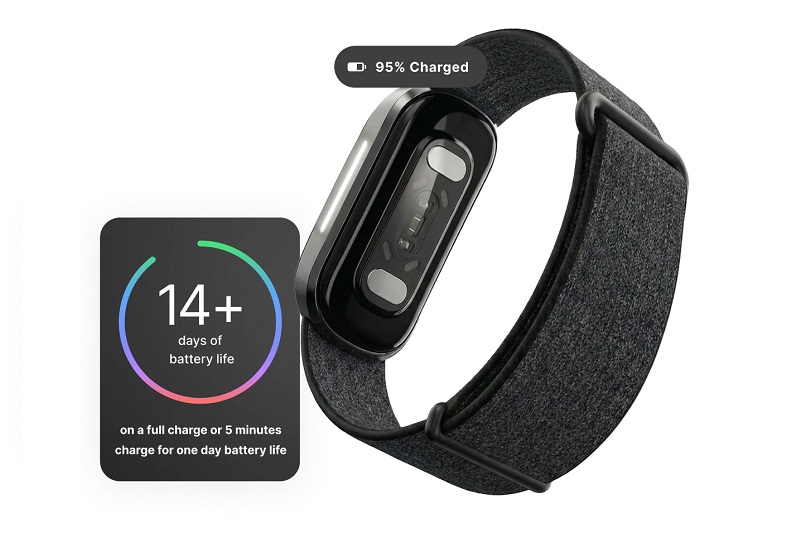
Screenless, Low-Profile Shell: Built to prevent screen distraction and improve battery life, using an IP68-rated waterproof case.
-
Asymmetry & Water Balance Mapping: Uses data from the scale to highlight muscle imbalances between limbs and monitor cellular hydration levels.
Real-World Use Cases and Practical Benefits
1. Preserving Lean Muscle Mass During Fat Loss
When people use GLP-1 medications or stick to strict calorie deficits, losing muscle mass alongside fat is a common risk. The Hume ecosystem helps manage this by giving you highly detailed body composition data.
If the scale shows your skeletal muscle mass is dipping, the app cross-references your wristband data to see if your sleep quality or daily activity levels are holding you back. This makes it easier to adjust your routine and protect your metabolic rate.
2. Monitoring Fatigue and Optimizing Workout Recovery
Instead of following a rigid workout routine regardless of how tired you feel, you can use the device’s morning HRV and resting heart rate data to gauge your actual recovery. If your HRV drops significantly, it’s a clear sign your nervous system is stressed, letting you know it’s a better day for a light walk than a heavy lifting session.
3. Tracking Hydration at a Cellular Level
The system breaks down water weight into intracellular water (the fluid inside your cells) and extracellular water (fluid outside the cells). This helps you see the difference between true cellular hydration and temporary bloating or water retention, making it much easier to fine-tune your daily fluid and electrolyte intake.
Who it makes sense for
This band is a better fit for people who already care about sleep, recovery, and wellness tracking. It also makes sense for users who like seeing trends instead of relying on guesswork.
It may be a good match if you:
-
Want a wearable focused on health insights rather than smartwatch features.
-
Prefer long battery life.
-
Like the idea of tracking recovery and sleep in one place.
-
Are curious about longevity-style metrics.
-
Want something simpler than a full-featured smartwatch.
It is probably not the best choice if you:
-
Only want step counting and basic activity tracking.
-
Need app notifications, music controls, and smartwatch extras.
-
Expect medical-grade readings from a wrist device.
-
Do not want to spend time learning what the data means.
Evaluating the Pros and Cons
The Advantages
-
Screen-Free Design: Eliminates the distraction of constant wrist vibrations and blue light, making it easy to wear all day and night.
-
Deep Structural Data: Delivers comprehensive body composition insights that traditional fitness trackers miss, including segmental muscle distribution and cellular fluid levels.
-
Unified Health Tracking: Connects your daily activity and recovery data with long-term body composition changes in one app.
-
Long-Term Reliability: The available 10-year hardware and sensor warranty provides excellent coverage for your long-term health journey.
The Drawbacks
-
Requires the Hume Scale for Full Value: The wristband works best when paired with the Hume Body scale; using it on its own cuts out the deeper body composition features.
-
App-Dependent Interface: Because the band has no screen, you have to open the mobile app anytime you want to check your real-time stats or metrics.
-
Requires Regular Engagement: To get the most out of the AI recommendations, you need to log your measurements consistently each week.
Safety, Comfort, and Material Wearability
The sensor pod uses medical-grade polymers and hypoallergenic stainless steel contacts to lower the risk of skin irritation during long periods of wear. The soft, woven fabric strap distributes pressure evenly across the wrist, making it much more comfortable for overnight sleep tracking than bulky silicone bands.
Because the device uses passive optical and thermal sensors, it does not emit thermal radiation or cause electrical stimulation. It is entirely safe for continuous daily use.
Important Safety Note: Because the accompanying Hume Body smart scale uses Bioelectrical Impedance Analysis (BIA)—sending a tiny, unnoticeable electrical signal through the body—the scale portion of the system should not be used by individuals with pacemakers, internal defibrillators, or other active implantable medical devices.
What users may like or dislike
The most common appeal of a device like this is that it gives a more complete picture than a typical fitness band. People who enjoy health data often like being able to check sleep, recovery, and energy patterns in one place.
On the other hand, users who expect instant clarity may be disappointed. The app experience matters here, and the device is only useful if the person wearing it actually pays attention to the results.
So the divide is pretty simple:
-
Data-oriented users may find it helpful.
-
Casual users may find it too detailed.
Pricing, Acquisition, and Warranty Protection
The Hume Health Band 2.0 is available directly through the official Hume Health online store. Purchasing the tracker includes access to the core features of the companion mobile app without forcing you into a mandatory monthly subscription.
| Offering | Included Status | Features Covered |
| Core Software Tier | Included with Purchase | Standard biometric logging, baseline trends, no monthly fees |
| 10-Year Protection | Optional Add-on | Hardware shell, advanced sensors, accuracy recalibrations |
When checking out, you can choose to add an extended 10-year hardware and sensor warranty. This plan covers the physical outer shell and internal sensors and includes performance recalibrations over the decade to keep the metrics accurate as the hardware ages.
Returns and Satisfaction Policies
The system comes with a 30-day money-back guarantee. This gives you a full month to set up the device, link it with the mobile app, and see how the metrics fit into your daily routine. If the screenless design or data setup doesn’t match what you’re looking for, you can return the hardware within the 30-day window for a refund of the purchase price.
Frequently Asked Questions
Q. Can I use the wristband without the Hume Body scale?
Yes, the wristband works on its own to track heart rate, sleep stages, HRV, and daily movement. However, to get the full benefit of the 45 structural health metrics—like segmental muscle mass and intracellular water tracking—you will want to pair it with the Hume Body scale.
Q. How long does the battery last on a single charge?
Because the device does not have a battery-draining screen, it typically lasts several days on a single charge. This makes it easy to track your sleep consistently without needing to charge it every single night.
Q. Is there a monthly subscription fee to view my health data?
No, the core companion app does not require a mandatory monthly subscription to view your daily biometrics, which sets it apart from several other screenless recovery trackers.
Q. Is the wristband waterproof?
Yes, the sensor pod features an IP68 waterproof rating. It is built to handle sweat, heavy rain, showers, and shallow swimming without any issues.
System Overview and Final Summary
The Hume Health Band 2.0 represents a thoughtful shift away from high-distraction smartwatches toward focused, purposeful health monitoring. By dropping the screen and prioritizing long-term biometrics, it provides a clean, unobtrusive way to stay on top of your data.
The system is particularly valuable for anyone navigating significant body changes—whether that is building lean muscle, managing clinical weight loss, or working to optimize recovery. By pairing daily wristband tracking with the detailed structural data of the smart scale, the Hume ecosystem helps take the guesswork out of your health, making it much easier to understand exactly what your body needs.